Most teams drown in failed agent runs and never lock the one that worked.
They collect stack traces, bad tool calls, and angry tickets. They rarely freeze a clean end-to-end success and treat it as sacred. The next prompt tweak, model bump, or tool schema change quietly bends that path. The demo still "looks fine." Customers feel the drift first.
I call the missing control a Golden Trace: one real successful run you refuse to lose — inputs, plans, tool calls, intermediate state, final outcome — frozen as the regression anchor for every later change.
Smoke evals catch the traps. Golden Trace proves the happy path you already earned still holds.
Quick use case
Situation. A platform team shipped an internal "invoice exception agent." It could read a flagged invoice, pull the PO and receipt lines, open a clarifying ticket when amounts diverged, and close the exception when the math matched. One Friday afternoon path worked end to end: correct PO match, one clarifying question, clean close. Leadership celebrated. Nobody saved the run.
What broke. Two weeks later a "harmless" prompt polish and a new retrieval index shipped. The agent still sounded sharp. It started closing exceptions when the PO line was close enough, skipping the clarifying ticket. Finance caught it in a weekly audit. Traces showed answers. They did not show which milestones of the original Friday path had disappeared. There was no frozen success to regress against — only a pile of failure tickets from earlier weeks.
The fix (Golden Trace).
- Pick one proven success — the Friday path that matched PO → asked once → closed clean
- Freeze the full trace — input invoice, tool calls + args, intermediate checks, final status, cost
- Name the milestones — "PO exact match," "clarify if delta > $X," "no close without receipt line"
- Regress on every change — prompt, tool schema, model, or index bump must hit the same milestones
- Fail closed on drift — if a milestone vanishes, CI red; no "looks good in staging" override
Same model. Same tools. A locked success path the team could no longer accidentally erase.
Failure logs teach. Success paths prove.
A failure log answers: What went wrong that time?
A Golden Trace answers: Does the path that already worked still work on this exact change?
Those are different questions. Most LLM ops programs only fund the first.
Smoke evals (the trap pack) guard the bad paths. Golden Trace guards the good one you already paid for in debugging time. Without both, you either ship polite bricks or silent regressions that still pass a vibe check.
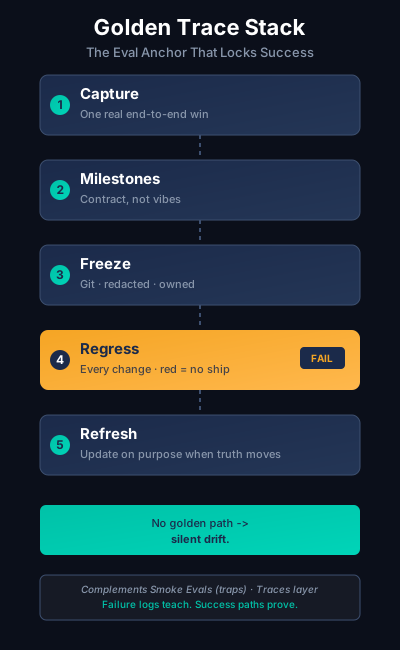
The Golden Trace stack (five layers)
Build it like a control, not a screenshot in Slack.
1. Capture (one real win)
Do not synthesize a perfect run in a notebook. Capture a production-like success:
- Real-ish inputs (redact secrets / PII)
- Every tool call with typed args and results
- The decision points that mattered
- The final business outcome, not just the last model sentence
If you cannot replay it, it is not a Golden Trace. It is a story.
2. Milestone contract
A full token dump is too brittle. Extract the milestones that define success:
- Required tools in order (or allowed set)
- Hard checks that must still pass (exact match, threshold, human gate)
- Forbidden shortcuts (skip clarify, invent a line, close on "close enough")
- Exit condition that matches the business outcome
Milestones are the contract. The raw trace is the evidence.
3. Freeze in version control
Store the golden artifact next to the code:
- Trace JSON (redacted) + milestone assertions
- Linked smoke-eval case IDs if the same path has trap variants
- Owner and last-reviewed date
If it is not in git, the next refactor will "simplify" it away.
4. Regress on every change that can bend the path
Run Golden Trace checks when you change:
- System / developer prompts
- Tool schemas or auth scopes
- Model version or temperature defaults
- Retriever / RAG index that feeds the agent
Red means no ship. "Staging still looks fine" is how the invoice agent learned "close enough."
5. Refresh when the product truth moves
When the real success criteria change — new policy, new required human gate, new tool — update the Golden Trace on purpose. Do not let an outdated golden become a museum piece that blocks good ships, and do not silently drift the milestones to match a worse path.
A Golden Trace is a living contract with the last path you were proud of.
How this maps to what you already have
- 5-layer agent stack — Golden Trace lives in Traces; Guardrails + Rollback catch what drift still slips through
- Smoke evals — trap cases block the bad paths; Golden Trace locks the good one
- Ship Gate — gate #3 (eval set) should include at least one golden success, not only failures
- Permission Envelope — if a milestone requires a fresh human grant, the golden must assert that the grant was present and not silently skipped
Architecture without a locked success path is just hope with better diagrams.
The test
Ask one question before the next agent ship:
Do we have one versioned successful run — with named milestones — that CI fails if this change drifts off it?
If the answer is no, you are still shipping on demo confidence and failure archaeology.
Closing
I'm Wasim Sheikh — AI Architect. I build systems teams trust and organizations depend on: not demos, not proofs of concept — production.
Follow for practical AI architecture that ships.
Connect on LinkedIn: Wasim Sheikh
Related: Smoke Evals Before You Ship · Permission Envelope · Ship Gate · The 5-Layer Agent Stack