Most teams give an AI agent a capability once and never take it back.
That is not consent. That is a standing power of attorney with no end date.
The model asks for calendar access, a CRM write, or a deploy token. Someone clicks allow. Three weeks later the same grant is still live — for a different task, a different tenant context, and a tired engineer who forgot what they approved. When something goes wrong, the logs show "authorized." They do not show when the human last meant it.
I call the missing control a Permission Envelope: a short-lived, scoped grant that dies unless a human renews it. Expiry is not bureaucracy. Expiry is the audit trail that proves consent was still fresh when the tool fired.
Quick use case
Situation. A platform team shipped an internal "release assistant." It could read a PR, draft release notes, and — with an approved toggle — open the production deploy ticket and page the on-call channel. Staging demos used a long-lived service account so nobody had to re-auth every run.
What broke. Two sprints later, a noisy alert chain made the agent open a deploy ticket for the wrong service and page the wrong rotation. The grant that allowed "open ticket + page" had been approved once for a canary release. It never expired. There was no re-ask, no TTL on the capability, and no log line that said "last human consent: 19 days ago for a different change." Security called it authorized. Ops called it a near miss.
The fix (Permission Envelope).
- Scope the grant — "open deploy ticket for service X + page rotation Y" — not "any ticket, any channel"
- Bind to a purpose — one change ID / one release window; the grant cannot be reused for a different PR
- Set a short TTL — minutes or hours for irreversible tools; days only for read-only
- Re-ask on expiry — silent renewal is forbidden; a fresh human intent is the only path back in
- Log consent, not just auth — who approved, what they saw, when it expires, and which action consumed it
Same agent. Same model. Different blast radius. The next wrong-service page never left the draft state.
Permission Envelopes aren't about distrusting the model. They're about refusing to let yesterday's yes authorize today's irreversible action.
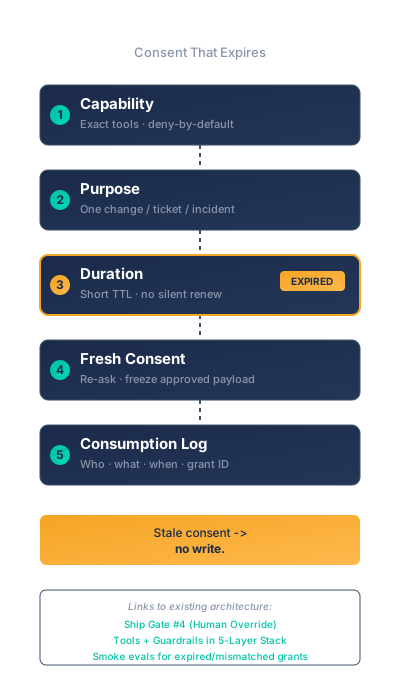
Why permanent grants fail quietly
Auth answers: Is this identity allowed to call the tool?
A Permission Envelope answers: Did a human still mean this specific action, for this purpose, right now?
Those are different questions. Most agent stacks only ask the first.
Service accounts and OAuth tokens are great at surviving restarts. They are terrible at remembering that the human clicked "allow" for a canary, not for every future Tuesday. Permanent grants optimize for fewer clicks. Production optimizes for fewer surprises at 2 a.m.
The Permission Envelope stack (five layers)
Build the grant like a system, not a checkbox buried in settings.
1. Capability (what)
Name the exact tool surface: which write endpoints, which tenants, which channels. Prefer deny-by-default. "CRM update" is not a capability — "update ticket status on account A, fields status + note only" is.
If you cannot write the capability in one sentence a junior engineer understands, the grant is already too wide.
2. Purpose (why / which)
Bind the grant to a concrete work item: PR number, change ticket, incident ID, customer case. When the purpose changes, the envelope dies. Reuse across tasks is how "authorized" becomes meaningless.
3. Duration (how long)
Pick the shortest TTL that still lets the workflow finish:
- Irreversible writes (send, deploy, charge, delete, page) — minutes to a few hours
- Mutating drafts (create ticket, draft email) — hours, then re-ask
- Read-only — longer is fine; still expire so abandoned sessions don't linger
Auto-extend is a smell. If the job needs more time, the human should know.
4. Fresh consent (who / when)
Expiry must force a real re-ask: show the blast radius again, get an explicit approve, freeze the approved payload. Do not let the model regenerate the action after the click. Do not treat "still logged in" as "still consented."
The re-ask is the audit trail field teams keep skipping — and the one regulators and postmortems actually care about.
5. Consumption log (proof)
Every tool call that used the envelope records:
- Grant ID + scope + purpose
- Approver identity + timestamp + what they were shown
- Expiry + whether this call consumed or renewed
- Outcome (success / denied / expired mid-flight)
If you only log "token valid," you cannot reconstruct consent. You can only reconstruct hope.
How this maps to what you already have
- 5-layer agent stack — Tools get typed scopes; Guardrails deny out-of-envelope calls; Traces carry the grant ID; Rollback still matters when a consumed grant was wrong
- Ship Gate — threat model names "stale consent"; human override is the re-ask; observability is the consumption log
- Smoke evals — add cases where the grant is expired, purpose-mismatched, or too wide; CI should fail if the agent still fires the write
A Permission Envelope does not replace Ship Gate. It makes gate #4 (human override) real after the first approve — and every hour after.
The test
Ask one question before the next agent write-tool ships:
Can we show, for every irreversible action, who consented, to what scope, for which purpose, and when that consent expires — and does the tool refuse when any of those are missing or stale?
If any half is no, you are still shipping standing power of attorney.
Closing
I'm Wasim Sheikh — AI Architect. I build systems teams trust and organizations depend on: not demos, not proofs of concept — production.
Follow for practical AI architecture that ships.
Connect on LinkedIn: Wasim Sheikh
Related: The 5-Layer Agent Stack · Ship Gate: The Pre-Deploy Checklist · Smoke Evals Before You Ship