Most AI features don't fail in the model.
They fail at the gate.
Someone demos a shiny prompt. Leadership loves it. It ships. Then a customer pastes something weird, an agent calls the wrong tool, or a "helpful" answer invents an offer that never existed. The postmortem is always the same: we optimized for the demo, not for production.
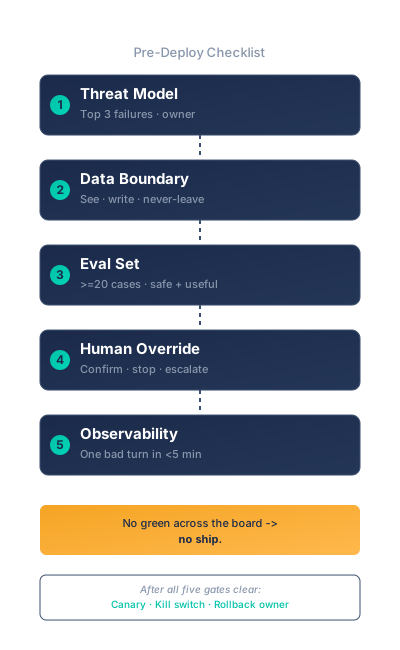
I call the missing step Ship Gate — a short, boring checklist you run before any AI feature leaves the sandbox. Not a 40-page risk memo. A gate you can clear in an afternoon.
Quick use case
Situation. A product team shipped an AI email summarizer into customer-facing replies. Staging looked clean. Leadership wanted it live before the quarter closed.
What broke. Day one, the model invented a discount a customer had never been offered. Support scrambled. There was no eval set of "known trap" emails, no human gate on outbound AI text, and no kill switch short of a full deploy rollback.
The fix (Ship Gate).
- Threat model — named "hallucinated commercial offers" as a top failure mode with an owner
- Data boundary — outbound copy restricted to template fields; free-form claims blocked
- Eval set — trap cases that fail the build if the model invents offers or leaks PII
- Human override — outbound AI copy held until a human approves (or stricter template mode)
- Observability — one bad reply reconstructable in minutes: prompt, context, output, cost
Then they added the ops layer every Ship Gate implies: canary traffic, a one-click kill switch, and a documented rollback owner before the flag flipped on.
Ship Gate isn't bureaucracy. It's the minimum checklist so an AI feature earns production — instead of learning in front of customers.
Why demos lie
Demos are curated. You pick the happy path. You soft-prompt around the edge cases. You never paste a raw customer email with secrets still in it.
Production is the opposite. Users paste junk. Models invent confident nonsense. Tools fire with the wrong args. Logs capture more than you think.
If your only test was "it looked good in the meeting," you didn't ship AI — you shipped a vibe.
Ship Gate exists to make that gap visible before customers feel it.
The five gates
Run these in order. Fail any one and you don't ship. Pass all five and you can sleep.
1. Threat model (ten minutes, not a committee)
Before code, write three sentences:
- What can go wrong? (wrong answer, tool misuse, data leak, prompt injection, cost runaway)
- Who gets hurt? (customer, employee, your brand, a regulator)
- What's the blast radius? (one chat vs. every tenant)
If you can't name the top three failure modes, you're not ready to build — you're ready to be surprised.
2. Data boundary
Answer out loud:
- What data can the model see?
- What can it write?
- What must never leave this boundary (PII, secrets, customer documents, internal tickets)?
Then enforce it in code, not in a slide. Strip secrets before the model. Scope tools to the minimum. Prefer retrieval over stuffing the whole corpus into context. If the model doesn't need a field, don't give it the field.
3. Eval set before polish
Pick 20–50 real-ish cases: happy path, hostile prompts, empty input, long paste, "ignore previous instructions," the ticket that always breaks things.
Score each on three axes:
- Correct enough for the job
- Safe enough (no leak, no unsafe action)
- Useful format (what the user actually needs)
Ship Gate rule: you don't tune the UI until the eval set is green enough that you'd trust a teammate to use the feature unsupervised.
4. Human override
Every autonomous or semi-autonomous path needs an escape hatch:
- Confirm before irreversible actions (send email, delete, charge, deploy)
- Log who approved what
- Make "stop / undo / escalate" obvious
If the only recovery path is "hope the model was right," you don't have a product. You have a liability with a chat box.
5. Observability that a human can read
When it breaks at 2 a.m., can you answer:
- What did the user ask?
- What context did the model get?
- Which tools ran, with which args?
- What did we return?
- Cost and latency for that turn?
If the answer is "we'd have to dig through JSON for an hour," fix the logs before you grow the feature. Ship Gate isn't complete until a tired engineer can reconstruct a single bad turn.
A one-page Ship Gate card
Print this. Tape it to the monitor.
| Gate | Pass criteria |
|---|---|
| Threat model | Top 3 failure modes named + owner |
| Data boundary | See / write / never-leave documented + enforced |
| Eval set | ≥20 cases; safe + useful bar met |
| Human override | Irreversible actions confirmed; stop path clear |
| Observability | One bad turn reconstructable in <5 minutes |
No green across the board → no ship.
The test
Ask one question before any AI feature goes live:
Which of the five gates is still red — and who owns fixing it?
If nobody owns the red gate, you don't have a launch plan. You have a calendar date.
Closing
I'm Wasim Sheikh — AI Architect. I build systems teams trust and organizations depend on: not demos, not proofs of concept — production.
Ship Gate is how intelligence features earn the right to leave the sandbox.
Follow for practical AI architecture that ships.
Connect on LinkedIn: Wasim Sheikh
Related: The 5-Layer Stack Behind Agents That Ship · Substack essay